Free Keyword Research Tool: The Free Stack That Works for Service Businesses
Which free keyword research tool should a Singapore clinic, firm, contractor or tutor use? Combine five free tools to find your first 30-50 keywords. See how.
From F&B to fintech, clinics to law firms, startups to enterprise. If your customers search on Google, we make sure they find you first, not your competitors.
One specialist team, focused only on the organic rankings that put you in front of ready-to-buy Singapore customers.
A clear, sequenced path from audit to rankings. You always know what we’re doing and why it matters for your leads.
Quick answer: NEA licensing SEO beauty Singapore businesses should navigate together means ensuring website and Google Business Profile content accurately reflects actual licensed services, since Singapore has no single beauty salon licence but does regulate radiation-emitting equipment and hygiene standards, and inaccurate claims create both compliance and trust risk.
Regulatory topics do not usually belong on an SEO agency’s blog, but for Singapore’s beauty and wellness sector, licensing accuracy and search visibility are more connected than most owners realise. NEA licensing SEO beauty Singapore businesses should navigate together sits at the intersection of two things that are easy to treat as separate: what a business is actually licensed and equipped to do, and what its website and Google Business Profile claim it does. This guide covers the general regulatory landscape a Singapore beauty or wellness business should be aware of, without asserting itself as the authoritative source on current requirements, and explains why accurate, honest content matters for search visibility just as much as for compliance. In our experience reviewing Singapore beauty and wellness websites, inaccurate or overstated service claims are a genuinely common and genuinely avoidable problem, one that carries real risk beyond just SEO, and one that a fairly small amount of careful content review can usually resolve.
A common misconception among Singapore beauty and wellness owners, and one we encounter regularly, is the assumption that a single, unified “beauty salon licence” exists and covers everything a salon or spa does. It does not. Instead, beauty salons and spas must comply with the Environmental Public Health Act’s general hygiene and premises standards, which the National Environment Agency (NEA) oversees. This covers general cleanliness, premises standards, and hygiene practice rather than a single licence document covering every possible service a beauty business might offer.
We have found that this misconception shows up in website copy surprisingly often, businesses referencing “our NEA licence” as though it were a single, all-encompassing credential, when the actual regulatory picture is more specific and more service-dependent than that phrasing suggests. Getting this right in content is not just a compliance nicety, it also reads as more credible and better-informed to anyone who actually knows the regulatory landscape, including increasingly well-informed customers who research a treatment before booking it.
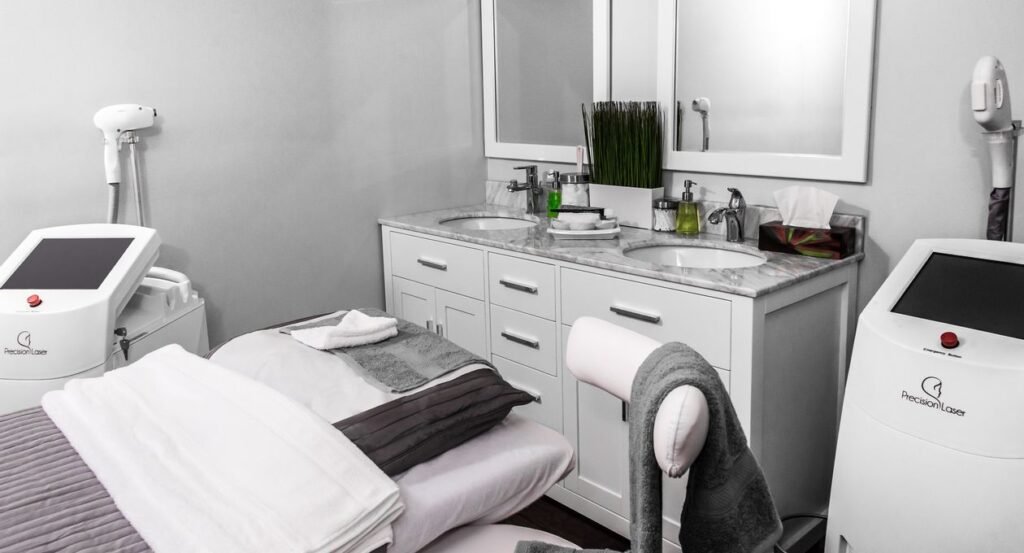
Where NEA licensing becomes specifically and directly relevant to search content is radiation-emitting equipment, covered under the Radiation Protection Act. This applies to spas or clinics offering laser hair removal, IPL, or similar light-based treatments, since ionizing and non-ionizing radiation-emitting equipment and facilities require proper licensing. Only licensed operators and premises may run this kind of equipment, and only registered medical practitioners may use higher-power class 4 lasers on humans, a distinction that matters enormously for how a beauty business should describe its own services.
When we review beauty and wellness website content mentioning laser or IPL services, the most consequential mistake is a business implying it offers a treatment level or equipment class it is not actually licensed or staffed to provide. This is not a minor wording issue, it is both a genuine compliance risk and, once noticed by a customer or a competitor, a serious trust risk that can be far more damaging than a slower, more conservative approach to service claims ever would be.
A closely related but genuinely separate licensing requirement covers massage services, reflexology, and some nail and wellness services, which fall under the Massage Establishments Act. This licence is administered by the Singapore Police Force, not NEA, which is a distinction worth stating clearly because the two authorities and their respective requirements are commonly confused, even by owners operating compliantly under both.
| Licensing Area | Governing Law | Administering Authority |
|---|---|---|
| General salon/spa hygiene and premises | Environmental Public Health Act | NEA |
| Radiation-emitting equipment (laser, IPL) | Radiation Protection Act | NEA |
| Massage, reflexology, some wellness services | Massage Establishments Act | Singapore Police Force |
| Cosmetic tattooing, microblading, piercing | No standalone licence; general hygiene law applies | General public health framework |
Businesses offering both massage-adjacent services and standard beauty treatments under one roof should be clear, internally and in their own understanding, that these sit under genuinely different regulatory frameworks and different administering authorities, even though both fall under the broader umbrella of Singapore business licensing that any owner must navigate.
There is currently no specific standalone licence for cosmetic tattooing, permanent makeup, microblading, or body piercing in Singapore. This does not mean these services operate without any oversight, hygiene and safety practices, sterilisation, proper needle disposal, and general premises standards are still expected under general public health law, but the absence of a dedicated licence category is worth understanding clearly rather than assuming it means no standards apply at all.
We have seen website content for businesses in this category occasionally overstate their regulatory position, implying a specific licence or certification exists for these services when the actual picture is closer to general hygiene compliance rather than a dedicated microblading or piercing licence. Accurate, honest framing here protects both the business and the customer researching a genuinely permanent or semi-permanent procedure before committing to it.
Field notes: Our beauty case study covered a non-medical Dempsey Hill day spa, so its 8 treatment landing pages described only what it actually offered, such as massage, facials and body wraps, with duration, pricing and contraindications for massage. Our aesthetic clinic case study shows the regulated end: a Novena clinic’s 8 procedure education pages were written strictly within SMC advertising guidelines. In both cases, content matched real capability, which is the point of this section.
Inaccurate service claims create risk on two separate fronts simultaneously. The compliance risk is the more obvious one, since claiming a licensed service without the appropriate licence, equipment, or qualified operator can expose a business to real regulatory consequences. The less obvious but equally important risk is to E-E-A-T, Google’s framework for evaluating experience, expertise, authoritativeness, and trustworthiness, since search engines and increasingly well-informed customers alike can identify overstated or inaccurate claims, and once identified, this damages trust in a way that is far harder to repair than the short-term visibility an exaggerated claim might have temporarily gained.
Most agencies frame licensing content purely as a legal compliance issue disconnected from SEO strategy, and that framing misses something important: content accuracy genuinely is an SEO issue for this category, because trust signals increasingly factor into how both search engines and customers evaluate a beauty or wellness business’s credibility, and a business making claims it cannot substantiate undermines exactly the trust signal the rest of its SEO work is trying to build. Our beauty industry SEO page covers how content accuracy fits into this broader trust-building picture.
Seasonal demand peaks, particularly pre-wedding season and pre-Chinese New Year grooming demand, often coincide with increased interest in treatments like laser hair removal or other equipment-dependent services, which makes accurate content especially important during exactly the windows when search volume and customer scrutiny are both highest. A business planning seasonal content or promotions around these treatment categories should double-check that its current service claims remain accurate and current before that content goes live, rather than reusing older copy without review.
This guide intentionally avoids stating specific fees, licence numbers, application timelines, or other precise regulatory details, since those specifics change and are best confirmed directly from the regulator rather than asserted by a blog post as though it were the authoritative source. Businesses and website content should point customers to NEA’s official website (nea.gov.sg) for current, accurate specifics on hygiene standards and radiation equipment licensing, and to the relevant authority for massage establishment licensing, rather than the business’s own content asserting itself as the final word on regulatory requirements. Our SEO consulting and audit service reviews this kind of content accuracy as part of a broader trust and compliance-aware content review.
Spas and clinics offering laser, IPL, or other radiation-emitting equipment treatments carry the most direct and consequential licensing exposure covered in this guide, and should review their website and Google Business Profile content with particular care to ensure claims match actual licensed capability. Standard beauty salons, nail studios, and hair salons offering conventional, non-equipment-dependent services carry lighter direct exposure under this specific licensing area, though general hygiene and premises compliance still applies universally regardless of service type. Our small business SEO service and full range of SEO services both include this kind of accuracy review as part of a broader engagement, regardless of business size.
Massage and wellness businesses should be clear about which authority, NEA or the Singapore Police Force, actually governs their specific service, since conflating the two in content or internal understanding is a common and avoidable source of confusion. Our about page covers more on how we approach content review for regulated or semi-regulated service categories generally, and our pricing page sets out how this kind of specialised content review fits into a typical engagement.
Review service claim accuracy on the website and Google Business Profile at least annually, or whenever a new treatment or piece of equipment is introduced, checking that current content matches actual licensed capability rather than assuming older copy remains accurate indefinitely. Monitor for any third-party content, directory listings, review mentions, or social media posts, that might misrepresent your actual service or licensing position, since inaccuracies can originate from sources beyond your own website. Track whether seasonal content updates, particularly around equipment-dependent treatments, are reviewed for accuracy before each seasonal push rather than reused unchanged year after year. Our beauty SEO case study shows how accurate, trust-focused content forms one part of a broader, sustained SEO engagement for a Singapore day spa.
It is worth being explicit about a distinction this guide has touched on indirectly throughout: standard beauty salons, spas, nail studios, and wellness centres sit under a genuinely different regulatory framework than medical aesthetic clinics, which fall under Ministry of Health and Health Sciences Authority oversight for treatments involving medical devices, prescription-strength products, or procedures performed by registered medical practitioners. This guide has focused specifically on the beauty and wellness category, hygiene standards under NEA, radiation equipment licensing, and massage establishment licensing, rather than the separate, more extensive medical regulatory framework that governs aesthetic clinics.
We have found that some Singapore beauty and wellness businesses blur this line in their own marketing, describing a treatment using language that implies medical-grade regulation or clinical oversight when the business genuinely operates under the beauty and wellness framework rather than the medical one. This is a particularly important distinction to get right in content, since implying a level of medical oversight a business does not actually have is a more serious claim, both in terms of compliance risk and customer trust, than most owners initially realise when drafting service descriptions or marketing copy.
A business genuinely unsure which regulatory category a specific treatment falls under, particularly anything bordering on medical-grade equipment or technique, is better served asking the relevant authority directly or consulting appropriately qualified professional advice than guessing based on how a competitor describes a similar service. Content accuracy in this specific area protects a business twice over, first from genuine regulatory risk, and second from the reputational damage of a customer or competitor publicly pointing out an inaccurate claim.
Treating licensing and service-claim accuracy as a one-time content review misses how much a beauty or wellness business’s service offering genuinely changes over time, new treatments added, older ones discontinued, equipment upgraded or replaced. Our clients who build a simple annual content review into their regular business calendar, checking service claims against current licensing and equipment reality, catch drift far earlier than those who only revisit this when prompted by an external audit or, worse, a customer complaint.
This same review habit is worth extending to staff-facing materials, not just customer-facing website and profile content, since front-of-house staff describing a service inaccurately to a walk-in customer creates the same trust and compliance risk as inaccurate website copy, even though it never shows up in any search engine review. A short annual briefing covering exactly what the business is and is not licensed or equipped to offer keeps everyone representing the business consistently, whether a customer encounters that information online or in person at the counter.
We have found that businesses treating this as a genuine, recurring compliance habit, rather than a one-time content correction exercise, are noticeably better positioned when a customer or a review does eventually raise a licensing-related question, since the answer is already consistent and accurate across every touchpoint rather than needing to be hastily corrected under pressure after the fact.
A business unsure where to begin can work through a short, practical starting sequence: first, list every treatment currently offered and confirm which regulatory framework, if any, genuinely applies to each one, general hygiene, radiation equipment licensing, or massage establishment licensing. Second, review the website and Google Business Profile line by line against that list, checking that no service is described in a way that overstates its actual licensed or clinical status. Third, set a recurring annual date to repeat this review, treating it as a standing item rather than a one-time correction exercise triggered only by this guide.
This sequence deliberately mirrors the broader, phased approach covered throughout this content series: diagnose honestly first, correct what is found, and then build the habit of periodic review so the same gap does not simply reappear a year later once the initial correction has been made and forgotten.
If you want a review of whether your salon or spa’s website and Google Business Profile content accurately reflects your actual licensed services, Singapore SEO Agency offers a free content accuracy review covering exactly this. No commitment, no sales pressure. Get in touch to arrange it.
In our experience, most beauty businesses either bury their NEA licensing information too deep in the site to build trust, or over-explain it in a way that reads more like a compliance document than reassurance for a nervous first-time client. We’ve seen the businesses that handle this best simply state their licence status plainly near the top of relevant service pages, with a short explanation of what it means for client safety, rather than treating it purely as a legal footnote. Our team recommends including licence numbers and renewal status directly on the page rather than linking out to a separate compliance page, since that small detail both builds trust with visitors and gives Google clearer, more specific content to index for licensing-related searches. We recommend pairing this with real photos of the premises and equipment where possible, because in our experience that combination does more for conversion than licensing text alone. One pattern worth watching: businesses that update this content only when licences are renewed tend to let it go stale between updates, and stale compliance content is one of the more overlooked trust signals that can quietly hold back an otherwise strong beauty and wellness listing in Singapore’s more heavily regulated treatment categories.
No. Singapore does not have one unified “beauty salon licence.” Beauty salons and spas instead comply with the Environmental Public Health Act’s general hygiene and premises standards, overseen by NEA, alongside any service-specific licensing that applies.
Yes, radiation-emitting equipment, including devices used for laser hair removal and IPL, falls under the Radiation Protection Act, which NEA administers. Only licensed operators and premises may run this equipment.
Only registered medical practitioners may use higher-power class 4 lasers on humans. This is a meaningful distinction that beauty and wellness businesses should reflect accurately in their website and marketing content.
No. Massage services, reflexology, and some nail and wellness services fall under the Massage Establishments Act, which is administered by the Singapore Police Force, a genuinely different authority from NEA.
Not currently a standalone licence, though general hygiene and safety expectations, sterilisation and proper needle disposal, still apply under general public health law even without a dedicated licence category.
Overstated or inaccurate service claims damage trust signals that both search engines and customers increasingly evaluate, and this trust damage is harder to repair than the short-term visibility an exaggerated claim might temporarily provide.
NEA’s official website, nea.gov.sg, is the appropriate source for current, specific requirements. General guides, including this one, should point businesses toward the official source rather than asserting themselves as the final authority.
Yes, particularly around seasonal peaks like pre-wedding season, when interest in equipment-dependent treatments rises. Reviewing content accuracy before reusing older seasonal copy helps avoid outdated or inaccurate claims going live again.
Our homepage has more on our overall approach to Singapore SEO, and the broader industry SEO hub covers how we approach content accuracy across other regulated or semi-regulated Singapore industries beyond beauty and wellness specifically.
Natalie leads SEO strategy at Singapore SEO Agency, helping local and regional businesses build organic search programmes that drive qualified leads. She specialises in technical SEO and content-led authority building for Singapore SMEs.
Get a free SEO audit for your Singapore website — we'll show you exactly where you stand, what's holding you back, and what it would take to rank on page 1.
Get Your Free SEO Audit →Which free keyword research tool should a Singapore clinic, firm, contractor or tutor use? Combine five free tools to find your first 30-50 keywords. See how.

SEO vs SEM is usually the wrong question. Learn what the terms really mean and how to use ads and Search Console data to decide which searches to earn or buy.

Google Search Console login problems usually start with verification and ownership. Learn how to get in, fix access errors and offboard agencies safely.

The click through rate formula is clicks divided by impressions. Learn what each platform counts, the averaging trap and how to set it up in Google Sheets.

A click through rate means nothing on its own. Learn to compare CTR by position, query type and SERP features, and see what low CTR is really telling you.

What a google analytics certification proves, what it misses, how to verify one and the practical questions to ask before you hire a marketer or freelancer.
Fast, no obligation. We reply within 24 hrs.
Singapore’s specialist SEO agency for SMEs. We rank your business on Google — and only Google. No distractions, just results.
© 2026 Singapore SEO Agency. All rights reserved.