
SEO Keyword Research Tool: How to Trial One Paid Tool Properly
Paying for an SEO keyword research tool? Test its Singapore data on 20 keywords you know, see why KD differs by vendor, and pick one tool you can stick with.
From F&B to fintech, clinics to law firms, startups to enterprise. If your customers search on Google, we make sure they find you first, not your competitors.
One specialist team, focused only on the organic rankings that put you in front of ready-to-buy Singapore customers.
A clear, sequenced path from audit to rankings. You always know what we’re doing and why it matters for your leads.
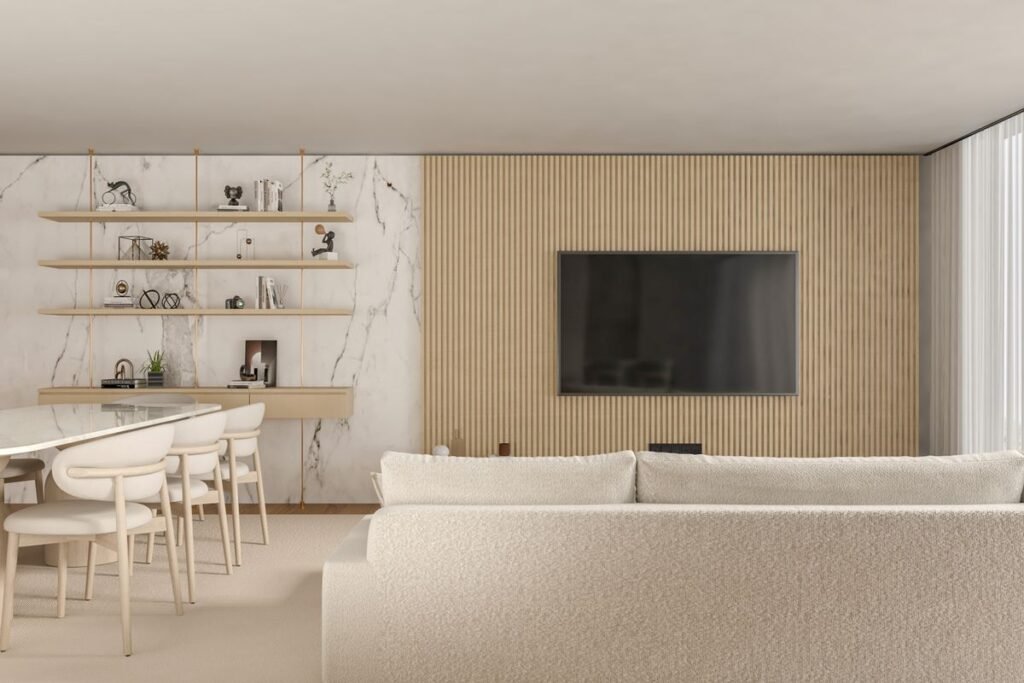
Quick answer: Interior design marketing works best when you treat finished projects as long-term assets. Professionally photograph a small number of your strongest jobs, write a full project story for each, then distribute that one asset across your website, Google, Instagram, Xiaohongshu, award entries and design press, instead of renting attention through ads.
Most interior design firms in Singapore spend their marketing budget the same way: a monthly ad budget, a listing fee on a renovation platform, and whatever phone photos the designer remembered to take on handover day. When the ads stop, the enquiries stop. What is left behind is a folder of blurry images and a website gallery nobody can find on Google.
This guide argues for a different allocation. Good interior design marketing is less about channels and more about raw material. One exceptionally documented project, photographed properly, written up as a full story and published as its own page, feeds search, social, press and platforms for years. Ad spend, by comparison, is rented attention: it disappears the day you stop paying.
We have seen this play out on real accounts, including our own interior design SEO case study, where a portfolio of 12 properly documented projects became the backbone of the firm’s search visibility. Below we cover what to shoot and what it costs in SGD, how to write project stories, how to approach awards and design media, how the designer’s own profile and showroom fit in, and how each asset becomes something Google can find and other sites can link to.
Start with a simple question: what does your marketing spend leave behind? A month of Google Ads or Meta Ads at S$2,000 to S$5,000 buys clicks during that month. When the campaign ends, nothing remains that keeps working. A professionally documented project costs a similar amount once, and then keeps producing value for as long as the work still represents your firm.
The reason is that a finished interior is the only marketing material a design firm cannot fake. Homeowners planning a renovation are not persuaded by slogans about “timeless spaces”. They want to see a 4-room flat like theirs, in a style they like, at a budget they can afford. Every channel you use is ultimately a way of putting that proof in front of them. So the quality of the proof sets the ceiling on every channel at once.
Here is how the two approaches compare across the things that matter to a small firm:
| Factor | Paid ad spend | One well-documented project |
|---|---|---|
| Typical cost | S$2,000 to S$5,000 per month, ongoing | S$1,500 to S$4,000 once (photography, styling, writing) |
| Lifespan of the output | Ends when spend stops | Useful for 3 to 5 years, often longer |
| Channels it feeds | One platform per campaign | Website, Google search and image search, Google Business Profile, Instagram, Xiaohongshu, Qanvast or RenoTalk profile, award entries, press pitches |
| Builds backlinks | No | Yes, when cited by press, awards or platforms |
| Improves with age | No | Yes, as reviews, links and rankings accumulate around it |
| What a competitor can copy | Your keywords and bids | Very little, the project is yours |
Most agencies will tell you to keep a steady monthly ad budget running so the pipeline never dries up. For an established firm with stretched capacity, that frequently backfires: ads bring in price-shoppers comparing five quotes, while the portfolio that would attract better-fit clients stays thin. In our experience working with Singapore renovation and ID firms, the firms with the healthiest enquiry quality are rarely the biggest ad spenders. They are the ones whose best work is easiest to find and easiest to believe.
None of this means ads are useless. It means ads should amplify assets you already own, not stand in for them. The same principle holds across most visual, high-consideration sectors we work in, which is why our industry SEO approach starts with an inventory of proof before any spend decision.
Photography is the single biggest lever in interior design marketing, and the most commonly under-funded one. Phone photos taken on handover day, with the client’s boxes still in the corner and the lights off, cannot compete with firms that commission a proper shoot.
What it costs in Singapore. These are typical ranges we see firms paying; quotes vary by photographer, location and usage rights:
Ask about usage rights before you book. Some photographers license images for your own website and social media only, and charge extra if a magazine or award body wants to publish them. Clarify this upfront, because press use is exactly where these images earn their keep.
What to shoot. A useful shot list covers:
Before/after is your strongest format. Homeowners in older HDB estates want to see what a dated 1990s flat can become. Shoot the “before” yourself on site measurement day, from the same angles you intend to use for the “after”. Most firms forget this step and only realise at handover that they have nothing to compare against. Make it part of your project kick-off checklist.
When we audited the image libraries of ID firms, the gap was consistently the same: plenty of finished photos, almost no matching “before” frames, and no record of which project each file belonged to.
Photographs alone are nearly invisible to search engines. Google reads text, so a gallery of 30 beautiful images with no words around them gives it almost nothing to rank. The fix is to give every documented project its own page with a proper written story.
A strong project story answers the questions a homeowner is silently asking while scrolling:
This is not just good storytelling, it is search-friendly content by design. A page describing a “Japandi 4-room HDB in Punggol” naturally contains the words a homeowner types into Google. That is the logic behind long-tail search (specific, multi-word searches with less competition and clearer intent), and it is where a small firm can outrank large ones.
Aim for 400 to 800 words per project page, plus captions under the key images. Write the before/after descriptions in plain language: “We removed the kitchen wall to open the space, then used a fluted glass partition to keep cooking smells contained.” That sentence does more selling than a page of adjectives.
We’ve seen firms resist publishing investment ranges for fear of scaring people off. In practice, a range filters out mismatched enquiries and saves your designers hours of wasted consultations. If your website currently lumps every project into one gallery, a restructure along these lines is often the first job in any contractor and renovation SEO engagement, because there is simply nothing for Google to index until the stories exist.
One more detail matters: give each page a descriptive URL, such as /projects/punggol-4-room-japandi/, rather than /portfolio?id=17. Clean URLs are easier for people to share and for search engines to understand.
Once you have a well-documented project, it becomes a candidate for two things that money cannot directly buy: award recognition and editorial coverage. Both carry weight with homeowners, and both tend to produce backlinks (links from other websites to yours, which Google treats as a signal of trust and authority).
Awards. In Singapore, the Singapore Interior Design Awards (SIDA), run by the Interior Design Confederation Singapore, is the most recognisable local programme for residential and commercial interiors. The President’s Design Award, run by the DesignSingapore Council, sits at the national level and is far harder to win. Regional programmes such as the Asia Pacific Property Awards also run interior design categories. Check each programme’s current categories, eligibility and fees directly, as these change from year to year.
What every award entry has in common is that it asks for exactly the material you should already have: professional photographs, a written project narrative, the brief, the constraints and the outcome. A firm that documents properly can enter with a few hours of editing. A firm that does not has to scramble for images months after handover, often when the client has already moved in and cluttered the space.
Design press. Local home and design media, including Home & Decor Singapore and the editorial sections of renovation platforms such as Qanvast, regularly feature completed homes. Editors look for a clear angle (a small flat that feels big, a bold colour choice, an unusual conversion), strong photography they are licensed to publish, and a designer who can answer questions quickly. A short pitch with three or four images and a one-paragraph story is usually enough to start a conversation.
Ask for the link. When a feature or award listing goes live, politely ask that it links to the specific project page rather than your homepage. A link pointing at a project page tells Google that this page is worth ranking for the searches it targets.
Conventional wisdom says awards are vanity spending. For an ID firm, that view misses the point: the entry fee is small compared with the photography, and the photography is reused everywhere. The award is a bonus on an asset you have already paid for. This is also where off-page work and on-page work meet, which is why we treat them together across our SEO services.
Interior design is a personal purchase. A homeowner is about to spend tens of thousands of dollars and share their home for months with someone they barely know. That is why, in small firms, the designer’s own profile often matters more than the company logo.
A practical designer brand does not require a large following. It requires:
This also supports what Google calls experience and expertise signals: evidence that real, qualified people stand behind the content. A project page that names the designer who led it, links to their profile, and shows the work is far more credible than an anonymous gallery.
The showroom or studio is the physical extension of the same asset. Many Singapore firms run a studio or material library where homeowners can touch finishes and see carpentry samples. Treat it as part of the portfolio rather than a separate cost centre:
We have seen firms with modest websites close more consultations than larger rivals simply because the studio visit felt like walking into their best project. When the showroom experience, the designer’s profile and the online portfolio all tell the same story, homeowners arrive already half-convinced. We apply the same thinking to our own business, which you can read about on our about page: the people and the evidence of past work should be visible before anyone is asked to make contact.
Instagram and Xiaohongshu (also known as RED, a Chinese-language lifestyle and review platform increasingly used by Mandarin-speaking homeowners in Singapore) are where many homeowners collect ideas before they ever search for a firm. The mistake is treating these platforms as a separate content treadmill that demands something new every day.
Most agencies will tell you to post daily to stay visible in the feed. For an interior design firm, that advice frequently backfires. A firm with three properly shot projects and pressure to post daily ends up filling the gaps with phone snaps, stock mood boards and reposted trends. The feed gets busier and the work looks weaker. A homeowner who scrolls your grid sees mediocre images sitting beside your best ones, and the average drags everything down.
A better approach is to treat social platforms as distribution channels for your documented projects:
The full story lives on your website. Social posts are excerpts that send people there. This matters because social content is temporary in a way that web pages are not: a post fades from feeds within days, while a project page can keep ranking on Google for years.
Renovation platforms work the same way. Your Qanvast or RenoTalk profile should showcase the same documented projects, with consistent branding and images, so a homeowner who sees your work on a platform and then Googles your firm name finds the same quality waiting for them.
The clearest evidence for this approach comes from our own work with a 4-person interior design and renovation firm working Singapore-wide. Before the engagement, the firm had a strong portfolio and repeat referrals, but no digital strategy beyond a Facebook page and an aged website with no portfolio content indexed on Google.
Starting position (Month 0):
What was done. The programme ran over 5 months in several phases. The phase most relevant to this guide was Phase 2, running across months 1 to 3: individual project pages were built for the firm’s 12 best past projects, each with before/after descriptions, a room-by-room scope breakdown, materials and finishes notes, the project timeline and an investment range rather than exact quotes. In parallel, the GBP was verified and rebuilt with 60 project photos added across completed rooms.
These sat alongside the other phases: a restructured site architecture with style and flat-type pages, budget-oriented content, and optimised Qanvast and RenoTalk profiles.
Ending position (Month 5):
| Metric | Baseline | Month 5 | Change |
|---|---|---|---|
| Organic sessions per month | 180 | 2,340 | +1,200% |
| Organic project enquiries per month | 7 | 22 | +214% |
| Style/segment keywords on page 1 | 0 | 9 | – |
| Domain Authority | 7 | 19 | +12 |
| GBP review count | 6 | 34 | +467% |
By month 3, the firm was receiving 11 leads a month; by month 5 it was at 22 and beginning to hire to manage capacity. To be clear, this result came from the whole programme, including the site restructure, GBP rebuild, budget content and platform optimisation, not from portfolio pages alone. But the documented projects were the raw material that every other phase drew on, from the GBP photos to the platform profiles. The full breakdown is in the case study linked in the introduction above.
A beautiful project only works as an asset if search engines and other websites can actually find and reference it. Many ID firms lose most of the value here through small technical oversights.
Image basics:
Page basics:
Making it linkable. Press features, award listings, supplier showcases and platform profiles are all natural sources of backlinks, provided there is a specific, high-quality page to link to. A gallery with no text gives an editor nothing to cite. A page with a clear story, credited photography and a named designer is exactly what an editor wants to reference. Brands whose materials you used, such as a laminate or tile supplier, will sometimes feature a well-documented project on their own site and link back.
Google Business Profile. Upload your best project photos to GBP, the free listing that appears in Google Maps and local results. Rotate in new documented projects over time rather than uploading everything at once.
For a small firm, getting these basics right is often the difference between a portfolio that quietly ranks and one that sits invisible. It is the kind of foundation work our small business SEO service is built around.
Field notes: In our contractor case study, an HDB and condo renovation contractor (12 workers) in Jurong East started with an unclaimed Google Business Profile and no portfolio content. The profile went live with 30 portfolio photos in months 1 to 2, 12 portfolio pages were indexed in months 3 to 4, and by month 6 monthly online enquiries had grown from 1 to 18. For an interior design or renovation firm, that is the case for treating documented project photography as a core marketing asset: the same shoots fed the profile, the portfolio pages and the enquiries that followed.
Interior design marketing is mostly a question of what you choose to own. Ad spend rents attention and returns it the moment the budget stops. A small number of exceptionally documented projects, professionally photographed, honestly written and published as proper pages, keeps working across search, social, press, awards and platforms for years.
If your budget is tight, our recommendation is simple: before funding another quarter of ads, fund the documentation of your three best jobs. Shoot the “before” on day one, commission proper photography at handover, write the story while the details are fresh, and distribute that one asset everywhere. For a sense of how ongoing SEO support for this kind of programme is typically structured and priced, see our pricing page.
Interior design marketing is everything a design firm does to attract and convert homeowners or commercial clients. That includes the website, project portfolio, search visibility, social media, renovation platforms, awards, press coverage and the showroom experience. The most effective approach treats finished projects as the core asset, because a well-documented project can be reused across every one of those channels, rather than relying mainly on paid ads that stop producing results once the budget ends.
Typical ranges are roughly S$500 to S$1,200 for a half-day HDB shoot, S$1,200 to S$2,500 for a condominium or landed home, and S$1,500 to S$3,500 for commercial spaces or showrooms. Styling and short walkthrough videos usually cost extra. Prices vary by photographer and by usage rights, so confirm upfront whether the licence covers press, award entries and platform use as well as your own website and social media.
Start with three to five of your strongest and most representative projects, ideally covering the styles and flat types you most want to win. It is better to have a small number of exceptionally documented jobs than dozens of thin gallery entries. Once that base is in place, add one or two newly documented projects each quarter so your portfolio stays current without becoming a burden on your team.
In most cases, yes. Publishing an investment range, not an exact quote, helps homeowners judge whether your firm fits their budget before they enquire. That filters out mismatched leads and saves designers time on consultations that were never going to convert. Ranges also add useful detail that homeowners search for. Keep ranges honest and update them if material or labour costs shift significantly.
They can be, provided you already have strong documentation. Award entries ask for professional photos and a written project narrative, which you should be producing anyway. The extra cost is mainly the entry fee and some editing time. Recognition adds credibility with homeowners and often produces a listing or feature that links back to your site. Check each programme’s current categories, eligibility rules and fees before committing.
Send a short, specific pitch to the editor: three or four strong images, a one-paragraph story with a clear angle, and confirmation that you hold the rights for publication. Editors favour homes with a distinctive idea, such as a small flat that feels spacious or an unusual conversion. Respond quickly to follow-up questions, and when the feature goes live, politely ask that it links to the specific project page on your website.
For firms serving Mandarin-speaking homeowners, it can be a useful discovery channel, because users actively search for renovation ideas by style, flat type and budget. Treat it as a distribution channel for your documented projects rather than a separate content stream. Write captions in Mandarin, include practical details such as flat type and approximate budget, and point readers back to the full project story on your website.
Consistency matters more than volume. Posting a few times a week using material from properly documented projects usually works better than daily posting filled with phone snaps or reposted trends. One well-shot project can supply 10 to 20 posts, including carousels, before/after pairs, detail shots and a walkthrough Reel, spread over several weeks. Quality of the grid is what a prospective client judges you on.
Each project page gives Google written content to understand and rank, such as the style, flat type, estate, materials and budget range. These match the specific searches homeowners run while researching. Well-documented pages also attract links from press, awards and suppliers, which strengthens your site overall. Clean URLs, descriptive alt text and compressed images help search engines read and load the page efficiently.
Not necessarily. Ads can be useful for amplifying strong assets, such as promoting a newly published project to homeowners in a specific estate. The problem arises when ads replace the assets rather than support them. If your portfolio is thin, fund documentation first, because better proof improves the performance of every channel, including paid ones. Once the assets exist, ad spend tends to convert at a better rate.
If you are not sure whether your portfolio is working as an asset or just sitting in a gallery, we can take a look. A free SEO audit reviews how your project pages, images and listings currently appear on Google, and where the gaps are. No commitment and no pressure. Book your free SEO audit.
If you would rather talk it through first, get in touch and tell us about the three projects you are proudest of.
Natalie leads SEO strategy at Singapore SEO Agency, helping local and regional businesses build organic search programmes that drive qualified leads. She specialises in technical SEO and content-led authority building for Singapore SMEs.
Get a free SEO audit for your Singapore website — we'll show you exactly where you stand, what's holding you back, and what it would take to rank on page 1.
Get Your Free SEO Audit →Paying for an SEO keyword research tool? Test its Singapore data on 20 keywords you know, see why KD differs by vendor, and pick one tool you can stick with.

Whats bounce rate, and how is it different from exits, engagement time or dwell time? Learn what each one really answers and what to ask your SEO agency.

Google Analytics website traffic is a consented sample, not a head count. See where visits come from, why tools disagree and which number to trust each month.

Google analytics consulting services for Singapore SMEs: what consultants do, indicative SGD costs, deliverables to demand and red flags. Buy the right scope.

Bounce rate in GA4 is not the old Universal Analytics number. Learn what it measures now, why old benchmarks fail and how to judge each page by its job.

Yoast SEO helps most when its site-wide settings are right. See which settings to choose, what the traffic lights really mean and the mistakes to avoid.
Fast, no obligation. We reply within 24 hrs.
Singapore’s specialist SEO agency for SMEs. We rank your business on Google — and only Google. No distractions, just results.
© 2026 Singapore SEO Agency. All rights reserved.